

Have you ever seen a meteor streak across the night sky? For many years, people have been mesmerized by these flashes in the sky, leading to the common belief that they bring good luck and to make a wish when you see them. It may feel like meteors appear suddenly, but there’s a deeper science to them, with far more meteors in the sky than we often realize.
What Are Meteors?
Meteors are pieces of space debris, ranging from as small as a grain of sand to the size of a boulder. As they zip through Earth’s atmosphere at high speeds, friction with the air causes them to heat up and glow, creating the bright streak we see in the sky. Most meteors burn up completely before reaching the ground, but if they impact the ground they are labeled meteorites.
Why Are Some Meteors Different Colors?
One of the most interesting features of meteors is the colors they display as they burn up in the atmosphere. Different elements in the meteor’s chemical makeup produce specific colors when they combust. For example:
- Sodium creates an orange-yellow glow.
- Magnesium gives off a blue-green light.
- Nitrogen and oxygen in the atmosphere produce red hues.
- Calcium causes blue or violet trails.
- Iron results in a yellow tint.
This color variation adds another level of excitement to meteor watching, as you can try to guess which elements are present in the meteoroid based on the colors you see.
Why Do We See Meteors?
As a comet orbits the Sun, it leaves behind a trail of debris. When Earth passes through a comet’s trail of debris, the tiny particles collide with our atmosphere. These particles travel upwards of hundreds of thousands of miles per hour, and the friction from this speed makes them burn up, creating a flash of light we see from the ground.
When this happens, we see meteors or meteor showers, which occur at predictable times each year due to Earth’s orbit. During a shower, dozens of meteors can be visible per hour, especially when the sky is dark and free of light pollution.
How Can We See More Meteors?
No matter where you are, the key to viewing meteors is to find a location as far away from city lights as possible. Once you’re settled, kick back, relax and give your eyes time to adjust to the darkness.
Here are some of the best types of spots for viewing meteors:
- Rural Farmlands: Rural areas offer low light pollution and wide open skies perfect for stargazing and meteor watching.
- State Parks and Forests: Sounds like the perfect camping opportunity! These areas provide dark, quiet spaces away from city lights, making them great spots for viewing meteor showers.
- Secluded Coastal Areas: While inland locations are excellent, coastal regions near smaller, less developed towns also offer darker skies, particularly in rural areas near the coast.
When Is The Next Time We Can See A Meteor Shower?
Orionid Meteor Shower: October 20-21, 2024
One of the most exciting upcoming meteor showers is the Orionid meteor shower, which will peak in the early morning hours of October 20th and 21st. The Orionids come from debris left behind by Halley’s Comet and appear to come from the direction of the constellation Orion, hence the name.
During the peak of the Orionid shower, you can expect to see about 15-20 meteors per hour, though some years produce even more. The best time to see the meteors is just before dawn when the consteallation Orion is high in the sky.
The Orionids are visible in both the Northern and Southern Hemispheres, making it a great opportunity for many people to enjoy the show. In the Northern Hemisphere, position yourself so your feet face the southeast. In the Southern Hemisphere, your feet should face the northeast for best viewing opportunities.
Weather Outlook for October 20-21, 2024
The weather outlook for October 20-21, 2024 shows good conditions for seeing meteors in many parts of the country.
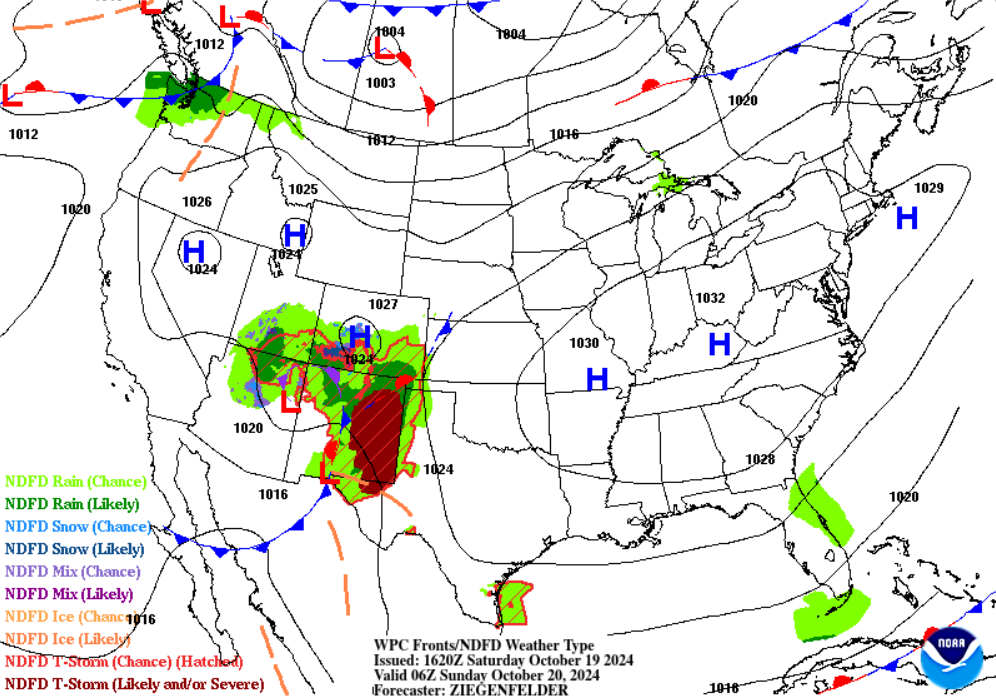
High pressure is keeping the skies clear across the East Coast, Southeast, Midwest, Northern Plains, and much of the Western U.S. This means there will be great conditions for viewing meteors in these areas in the early morning hours of October 20th.
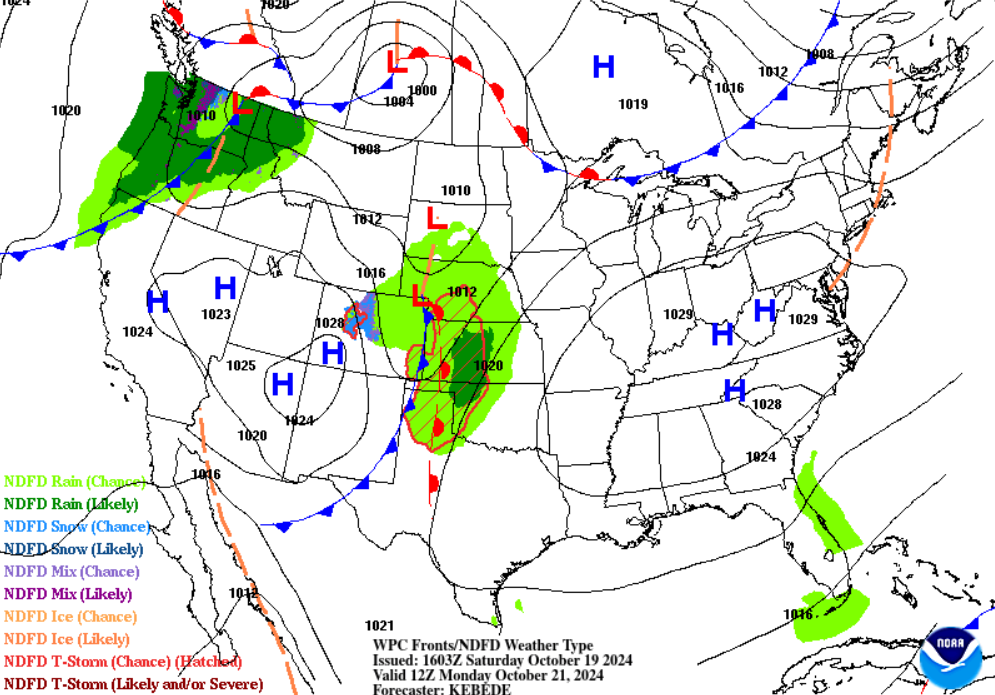
However, fronts in northwest Washington and a low-pressure system over the Four Corners region (Arizona, Utah, Colorado, New Mexico) are causing cloudy skies and rain, which will block the view of meteors. As the area of low pressure moves northeast on Sunday, October 20, clouds and rain will spread to the Eastern Rockies and Plains, affecting parts of Colorado and from South Dakota to Texas.
These areas will not be good for viewing meteors on both October 20th and 21st.
 Bama Beach Weather
Leave a comment